


AC and Heating
Heating a warehouse during the winter can be challenging, especially when dealing with large open spaces, high ceilings, loading docks, and frequently opened doors. Whether you’re heating a distribution center, manufacturing facility, construction site, or temporary storage building, choosing the correct heater capacity is essential.
One of the most common questions we receive at Climate Control Solutions is: How many BTUs do I need to heat my warehouse?
The answer depends on several factors, including building size, insulation, ceiling height, outdoor temperatures, and how often doors are opened.
In this guide, we’ll explain how to estimate warehouse heating requirements and introduce several commercial and industrial heaters available through Climate Control Solutions.
Understanding BTUs for Warehouse Heating
BTU stands for British Thermal Unit, a measurement of heating energy. Commercial and industrial heaters are typically rated in BTUs per hour (BTU/hr), indicating how much heating capacity they can provide.
For example, a 400,000 BTU/hr industrial heater has a much higher heating output than a 100,000 BTU/hr unit. However, that doesn’t automatically mean the larger heater is the correct choice.
An oversized heater may cycle excessively or create uneven temperatures, while an undersized heater may struggle to maintain the desired temperature during colder weather.
Proper heater sizing helps improve temperature consistency, fuel efficiency, and overall performance.
How to Calculate Warehouse Heating Requirements
Unlike residential spaces, warehouses often have high ceilings and large interior volumes. This means square footage alone isn’t enough to accurately determine heating requirements.
For a preliminary estimate, start with these steps.
Step 1: Determine Your Warehouse Size
Measure the length, width, and ceiling height of your warehouse.
For example, consider a warehouse measuring:
- Length: 100 feet
- Width: 80 feet
- Ceiling height: 20 feet
The total square footage is 8,000 square feet.
The total interior volume is:
100 × 80 × 20 = 160,000 cubic feet
This volume is important because heating requirements depend partly on how much air must be warmed and how frequently that air is replaced.
Step 2: Determine the Required Temperature Increase
Next, calculate the difference between your desired indoor temperature and the outdoor design temperature.
For example:
- Desired indoor temperature: 65°F
- Outdoor temperature: 25°F
- Required temperature rise: 40°F
A warehouse that needs to maintain 65°F when it’s 25°F outside will generally require more heating capacity than the same warehouse operating in a milder climate.
Step 3: Account for Insulation and Air Leakage
Warehouse heating requirements are significantly affected by heat escaping through walls, roofs, windows, and doors.
Well-insulated facilities typically require less heating capacity than older metal buildings or partially enclosed construction sites.
Loading docks and frequently opened overhead doors can also create substantial additional heat loss.
For forced-air heating, one useful estimate of the heat required to warm incoming outdoor air is:
BTU/hr = 1.08 × Airflow (CFM) × Temperature Rise (°F)
For the 160,000-cubic-foot warehouse in our example, an assumed outdoor-air exchange rate of 0.5 air changes per hour would equal approximately 1,333 CFM.
At a 40°F temperature difference, that results in approximately 57,600 BTU/hr just to warm the incoming air.
This is not the total heater requirement. Heat loss through the building structure, additional ventilation, loading dock activity, and warm-up requirements must also be considered.
For accurate equipment selection, a complete heat-loss calculation is recommended.
What Size Heater Is Best for a Warehouse?
The right heater depends on the warehouse’s actual heat-loss requirements, available utilities, and whether you need to heat the entire building or specific work areas.
Smaller industrial facilities may be adequately heated with a single portable heater, while larger buildings may benefit from multiple heaters strategically positioned throughout the space.
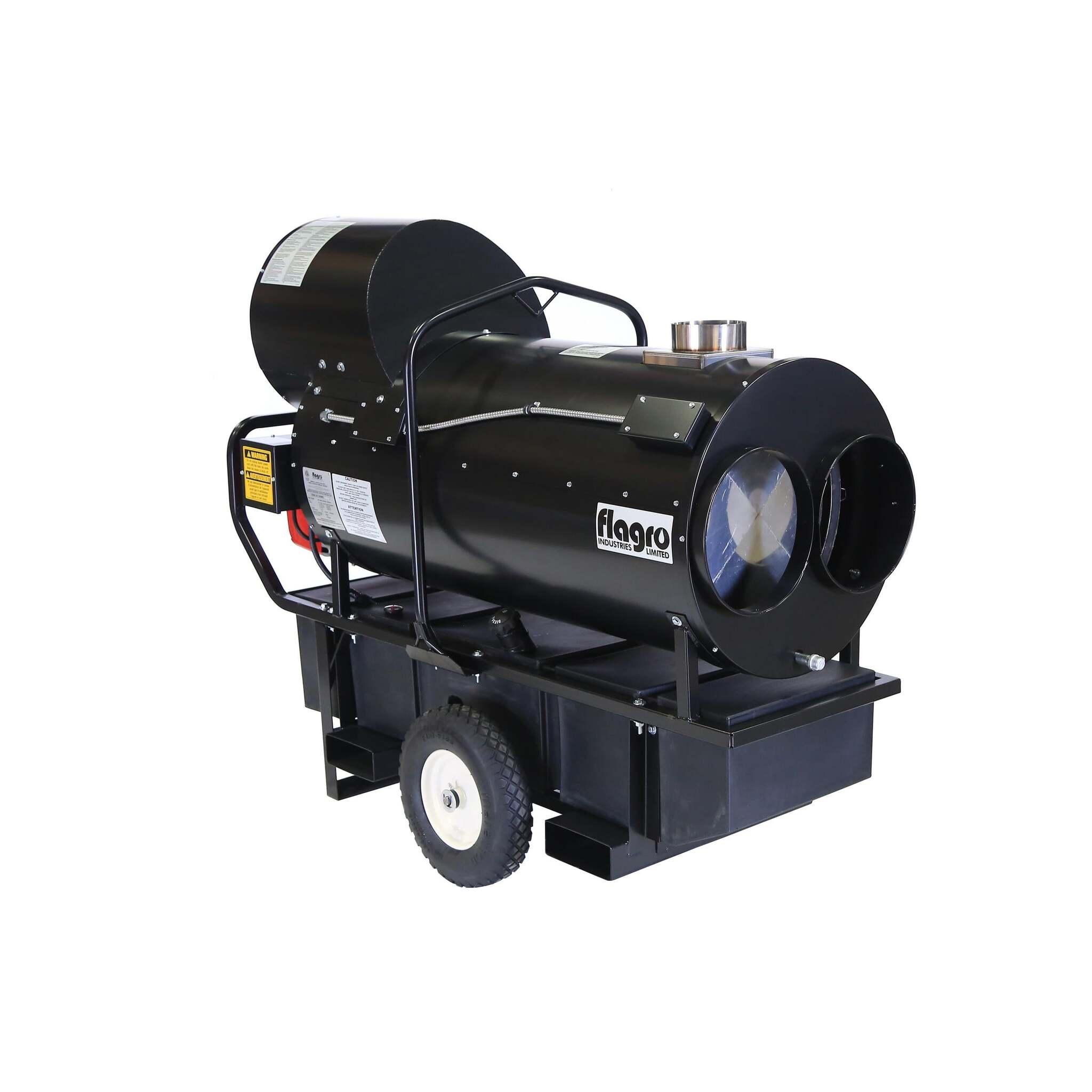
At Climate Control Solutions, we offer a range of industrial heating equipment from Flagro, including electric and indirect-fired models.
Recommended Portable Heaters for Warehouses
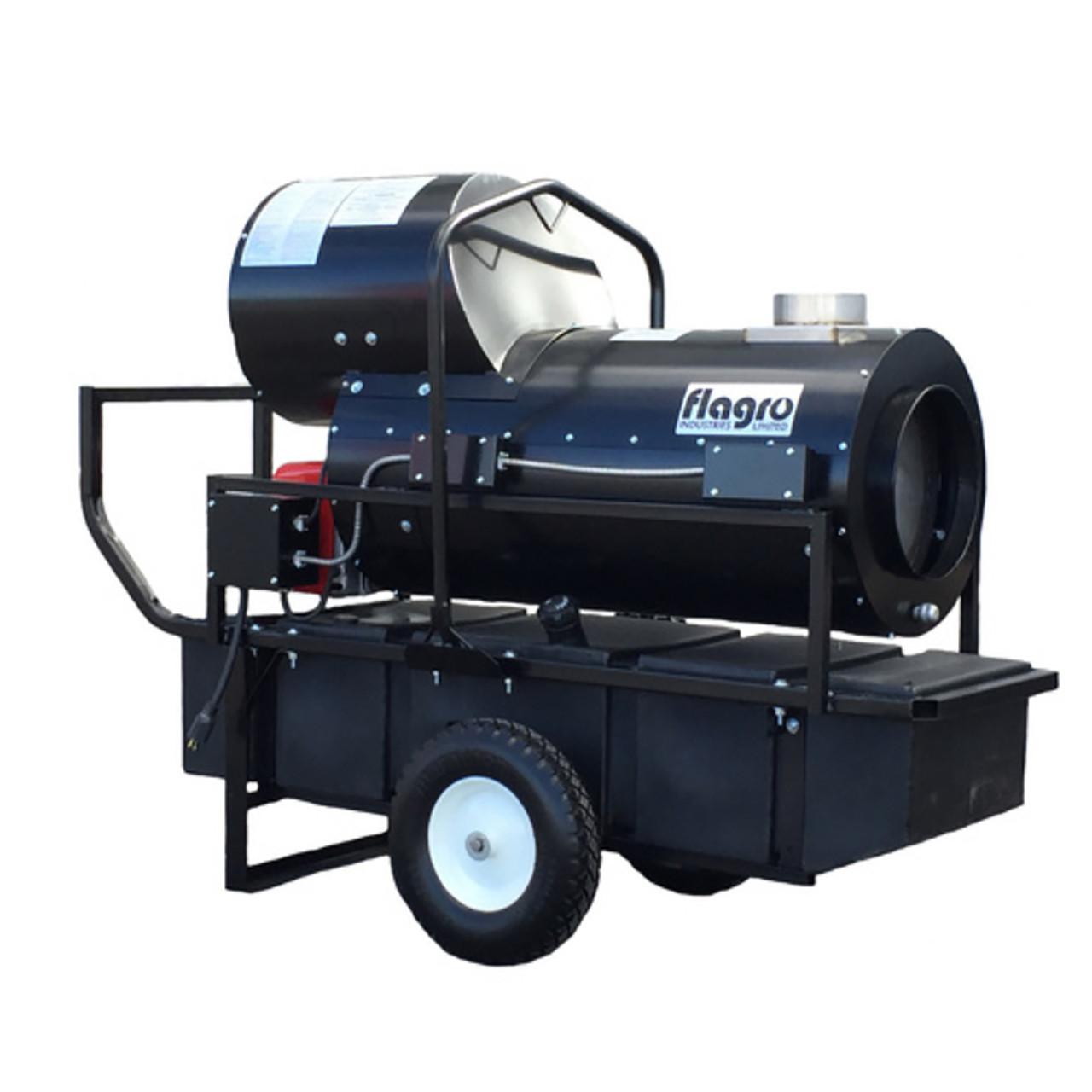
1. Flagro FVO-200RC42 – 185,000 BTU Indirect-Fired Heater
The Flagro FVO-200RC42 is a portable indirect-fired heater offering 185,000 BTU/hr of heating capacity.
This unit features a 42-gallon fuel tank, recirculation hood, and a portable design suitable for demanding commercial applications.
Key features include:
- 185,000 BTU/hr heating capacity
- 42-gallon onboard fuel tank
- Recirculation hood for improved heat retention
- Thermostatic temperature control
- Portable design with heavy-duty wheels
The FVO-200RC42 is worth considering for smaller warehouse zones, temporary construction heating, and applications where warm air needs to be delivered into an enclosed space.
Its indirect-fired design separates the combustion exhaust from the heated supply air when properly installed and vented.
2. Flagro FVO-400RC – 390,000 BTU Indirect-Fired Heater
For larger heating requirements, the Flagro FVO-400RC provides 390,000 BTU/hr of heating capacity.
This industrial heater is designed for demanding environments, including warehouses, manufacturing facilities, and construction sites.
Key features include:
- 390,000 BTU/hr heating capacity
- 4,000 CFM airflow
- 42-gallon fuel tank
- Recirculation hood
- Stainless-steel heat exchanger
- Flexible ducting options for directing heated air
The FVO-400RC is especially useful when heat needs to be distributed to specific areas or through ductwork.
For larger buildings, multiple heaters may be positioned in different zones to improve distribution and provide operational flexibility.
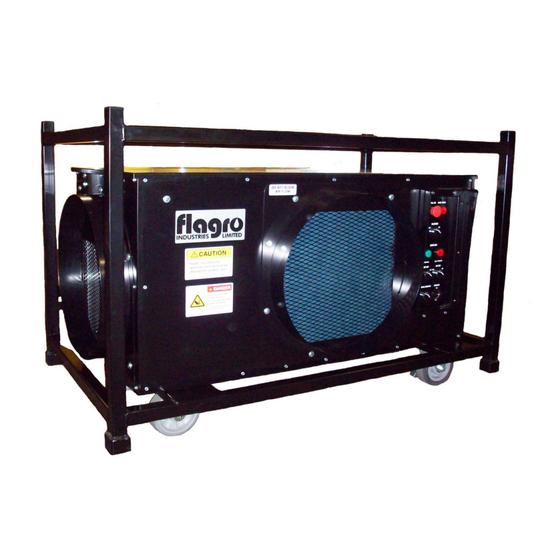
3. Flagro FLE-60RC – 60 kW Electric Heater
If your facility has sufficient electrical power and you prefer an electric heating solution, the Flagro FLE-60RC is another option.
This commercial electric heater provides up to 60 kW, approximately 205,000 BTU/hr, of heating output.
Key features include:
- 60 kW maximum heating capacity
- Adjustable 20, 40, and 60 kW heat settings
- Up to 5,200 CFM of airflow
- 480V three-phase electrical requirement
- Compatible with optional ductwork
- No on-site fuel combustion
Electric heaters are particularly attractive in applications where combustion exhaust is undesirable or fuel storage is inconvenient.
However, the available electrical service must be evaluated before choosing a large electric heater.
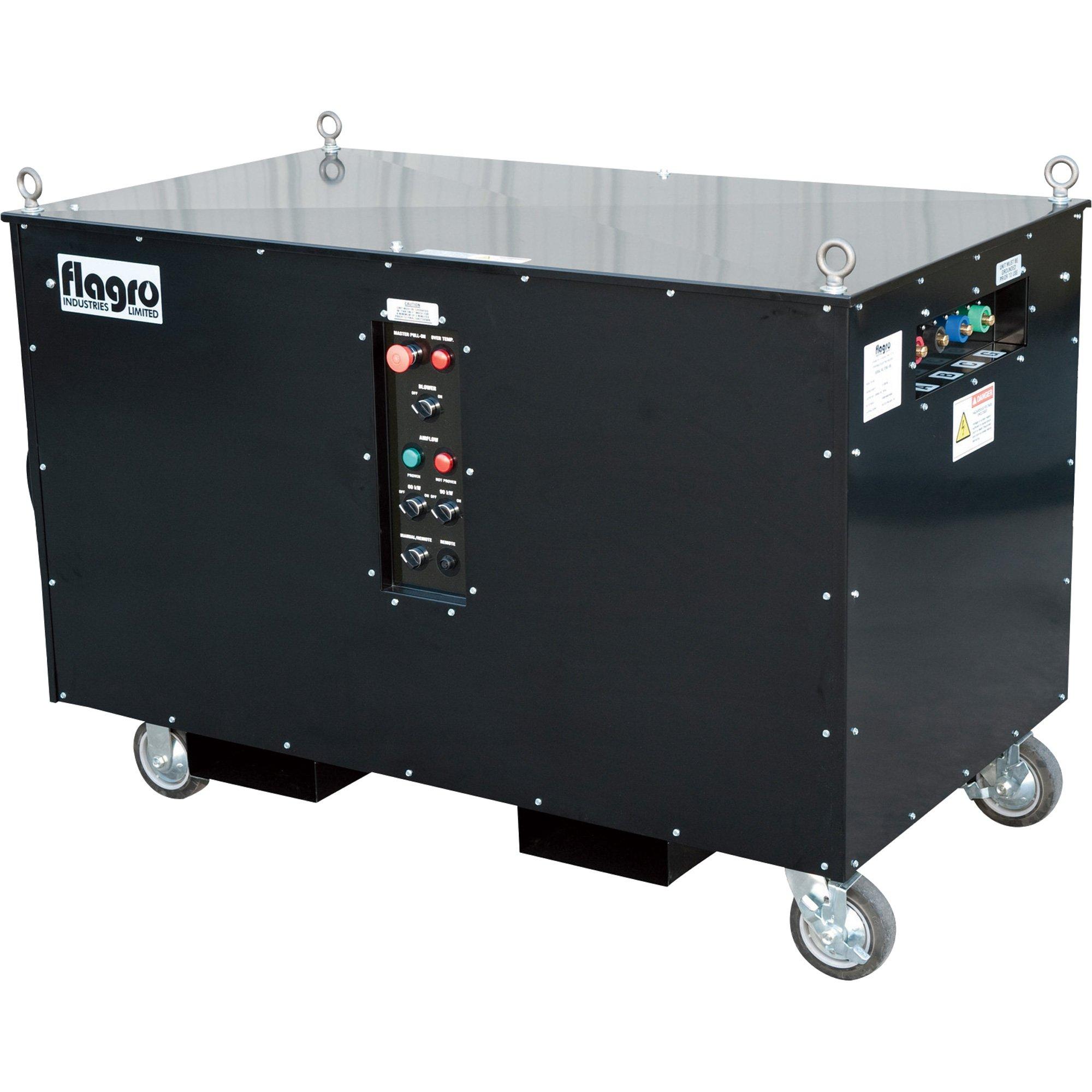
4. Flagro FLE-150RC – 150 kW Electric Heater
For high-capacity electric heating, the Flagro FLE-150RC delivers approximately 512,000 BTU/hr of heating output.
This powerful electric heater is designed for industrial facilities, large commercial buildings, and temporary heating applications.
It offers:
- 150 kW electric heating capacity
- Approximately 512,000 BTU/hr output
- 480V electrical operation
- Forced-air heating
- Duct-compatible warm-air distribution
The FLE-150RC can be an attractive alternative to fuel-fired heating when the facility has the necessary electrical infrastructure.
Should You Use One Large Heater or Multiple Smaller Heaters?
For some warehouses, multiple smaller heaters may offer advantages over one large unit.
For example, two 185,000 BTU/hr heaters provide a combined nominal output of 370,000 BTU/hr, while allowing heat to be distributed between separate areas.
Multiple units may offer:
- Better coverage of distant work areas
- Improved temperature control across zones
- Flexibility to move equipment as needs change
- Some heating redundancy if one unit goes offline
However, multiple heaters also require appropriate fuel or electrical connections, safe placement, and adequate airflow.
The best configuration depends on your facility layout and heating requirements.
Electric vs. Indirect-Fired Warehouse Heaters
Electric and indirect-fired heaters both have advantages.
Electric heaters do not create on-site combustion exhaust, making them useful for facilities with sufficient electrical service and restrictions on fuel-fired equipment.
Indirect-fired heaters use a heat exchanger to separate combustion exhaust from the supply air. They can provide substantial heating capacity without requiring the large electrical supply associated with electric resistance heaters.
Indirect-fired heaters still require proper exhaust routing, combustion air, clearances, and installation in accordance with manufacturer instructions and applicable codes.
For many temporary industrial heating applications, the decision comes down to available power, fuel logistics, heater capacity, and the layout of the facility.
Frequently Asked Questions About Warehouse Heating
How many BTUs do I need to heat a 10,000-square-foot warehouse?
A 10,000-square-foot warehouse cannot be accurately sized from square footage alone. Ceiling height, insulation, outdoor design temperature, ventilation, and door openings can dramatically change the heating requirement.
A proper heat-loss calculation is the best way to determine the necessary equipment capacity.
Can portable industrial heaters run continuously?
Many commercial and industrial heaters are designed for extended operation, but allowable operating schedules depend on the specific equipment, installation, and maintenance requirements.
Fuel consumption, electrical supply, ventilation, and safety controls must also be considered.
Are diesel heaters suitable for indoor warehouse heating?
Indirect-fired diesel heaters can be used for suitable warehouse applications when combustion exhaust is safely routed outdoors and all manufacturer and code requirements are met.
Direct-fired heaters have different ventilation and application requirements.
What information is needed to size a warehouse heater?
The most helpful information includes the building’s length, width, ceiling height, location, insulation condition, desired indoor temperature, loading dock activity, and available electrical or fuel connections.
Find the Right Warehouse Heater at Climate Control Solutions
Choosing the correct warehouse heater can make a significant difference in comfort, operating costs, and equipment performance.
Climate Control Solutions supplies commercial and industrial heating equipment for warehouses, manufacturing facilities, construction projects, and other demanding applications.
Whether you’re considering a Flagro indirect-fired heater or a high-capacity electric unit, our team can help you evaluate your application and identify suitable equipment.
Need help sizing a heater for your warehouse?
Contact Climate Control Solutions at (800) 633-8711 or browse our temporary heating solutions to explore available equipment and request a quote.