


AC and Heating
Reliable cooling is critical for data centers, server rooms, telecommunications facilities, and other environments housing sensitive electronic equipment. Even a temporary air conditioning failure can create operational risks as servers, networking equipment, and electrical components generate heat.
When permanent cooling systems cannot keep up with demand, portable industrial air conditioners can provide temporary or supplemental cooling.
At Climate Control Solutions, we supply commercial portable air conditioning equipment ranging from compact 1-ton spot coolers to high-capacity 12-ton systems.
In this guide, we’ll explain how portable air conditioners are used in data centers, how to estimate cooling requirements, and which Airrex cooling units may be appropriate for different applications.
Why Data Centers Need Reliable Cooling
Unlike offices or other traditional commercial spaces, data centers produce significant amounts of heat through continuously operating IT equipment.
Servers, networking hardware, storage systems, and power equipment generate heat that must be removed to maintain acceptable operating conditions.
Inadequate cooling can contribute to:
- High server inlet temperatures
- Equipment thermal throttling
- Unexpected shutdowns
- Reduced operating reliability
- Increased risk of equipment damage
- Disruptions to business operations
Effective data-center cooling requires more than lowering the average room temperature. It also involves maintaining proper airflow through equipment racks and preventing hot exhaust air from mixing with the cold air supplied to servers.
Portable cooling systems can be especially valuable when existing infrastructure is undergoing maintenance, experiencing a failure, or operating near its capacity limits.
When Should You Use a Portable Air Conditioner in a Data Center?
Portable air conditioning equipment can support several common applications.
Emergency Cooling During HVAC Failure
When an existing cooling system stops operating, portable air conditioners can help provide temporary cooling while repairs are completed.
Depending on the heat load and available infrastructure, equipment may be positioned near affected racks or connected to a planned temporary air-distribution arrangement.
Supplemental Cooling for High-Density Racks
Some data centers experience localized hot spots even when the main cooling system is operating normally.
These hot spots can develop when IT equipment is added, rack density increases, or airflow distribution becomes unbalanced.
Portable spot coolers may help address individual areas that require additional cooling.
Temporary Cooling During Facility Upgrades
Replacing or servicing existing cooling equipment can require temporary cooling support.
Portable air conditioners can help facilities maintain operations during planned maintenance, renovations, and equipment replacements.
Cooling for Server Rooms and IT Closets
Not every facility operates a large data center.
Many commercial buildings have smaller server rooms or IT closets that generate considerable heat but lack dedicated cooling infrastructure.
Compact portable spot coolers can be useful in these locations, provided the installation includes proper heat rejection and condensate management.
How Much Cooling Does a Data Center Need?
One of the most important factors in selecting a portable air conditioner is understanding the facility’s actual heat load.
Unlike conventional comfort cooling, data-center cooling is primarily driven by electrical equipment.
Most of the electricity consumed by IT equipment is ultimately converted into heat that must be removed.
A useful calculation is:
1 kilowatt (kW) of heat = approximately 3,412 BTU/hr
For example, if a server room has an IT equipment load of 20 kW:
20 × 3,412 = 68,240 BTU/hr
Because one ton of refrigeration equals 12,000 BTU/hr:
68,240 ÷ 12,000 = approximately 5.7 tons of cooling
This is the theoretical IT heat load alone.
Actual cooling requirements may also include heat from UPS losses, lighting, people, building heat gains, outdoor-air requirements, and other equipment. The cooling system’s sensible capacity at the intended operating conditions must be considered as well.
This is why choosing a portable AC based only on server-room square footage can result in inadequate cooling.
For critical facilities, a qualified mechanical engineer or data-center cooling specialist should verify capacity, airflow, redundancy, and operating conditions.
Recommended Portable Air Conditioners for Data Centers
Climate Control Solutions offers several Airrex portable air conditioners that may be used for temporary and supplemental IT cooling applications.
The appropriate unit depends on the amount of heat that needs to be removed, the facility’s electrical service, available space, and the ability to discharge condenser heat outside the cooled area.
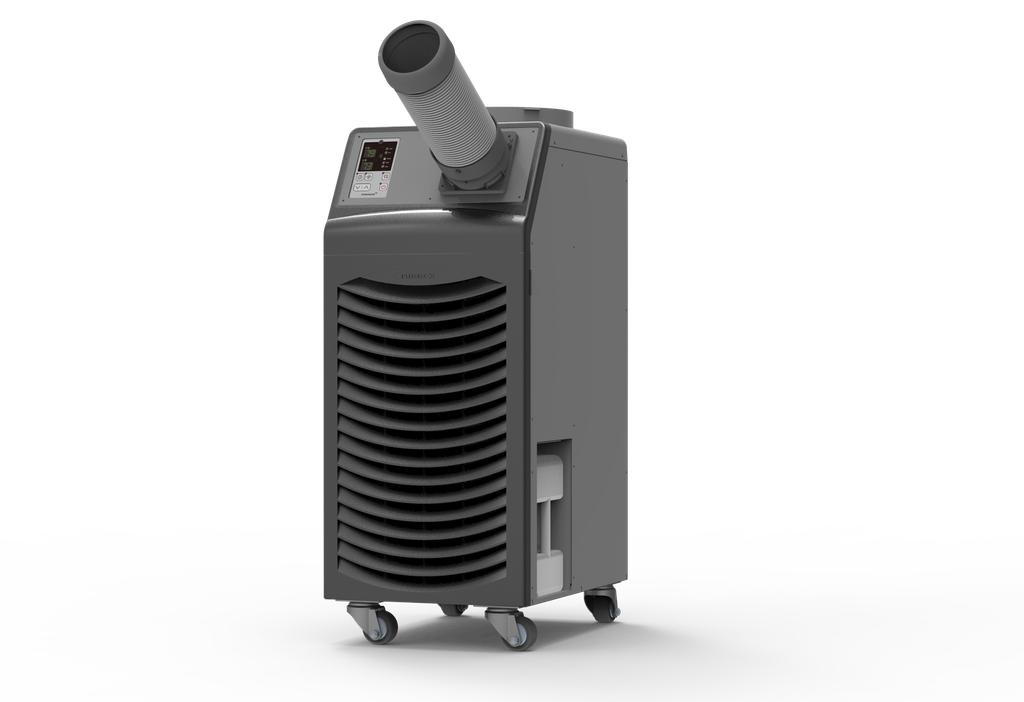
1. Airrex HSC-12R – 1-Ton Portable Spot Cooler
The Airrex HSC-12R is a compact portable air conditioner providing 12,000 BTU/hr of cooling capacity.
This unit can be an option for smaller IT closets, individual equipment areas, or limited supplemental cooling applications.
Key features include:
- 12,000 BTU/hr cooling capacity
- 1 ton of nominal cooling
- 115V single-phase electrical operation
- NEMA 5-15 plug
- R-454B refrigerant
- Portable design with swivel casters
- Optional condensate pump and exhaust accessories
The HSC-12R’s compact footprint can make it convenient for locations where a larger cooling unit would be difficult to position.
However, the total equipment heat load must be verified before choosing a 1-ton system.
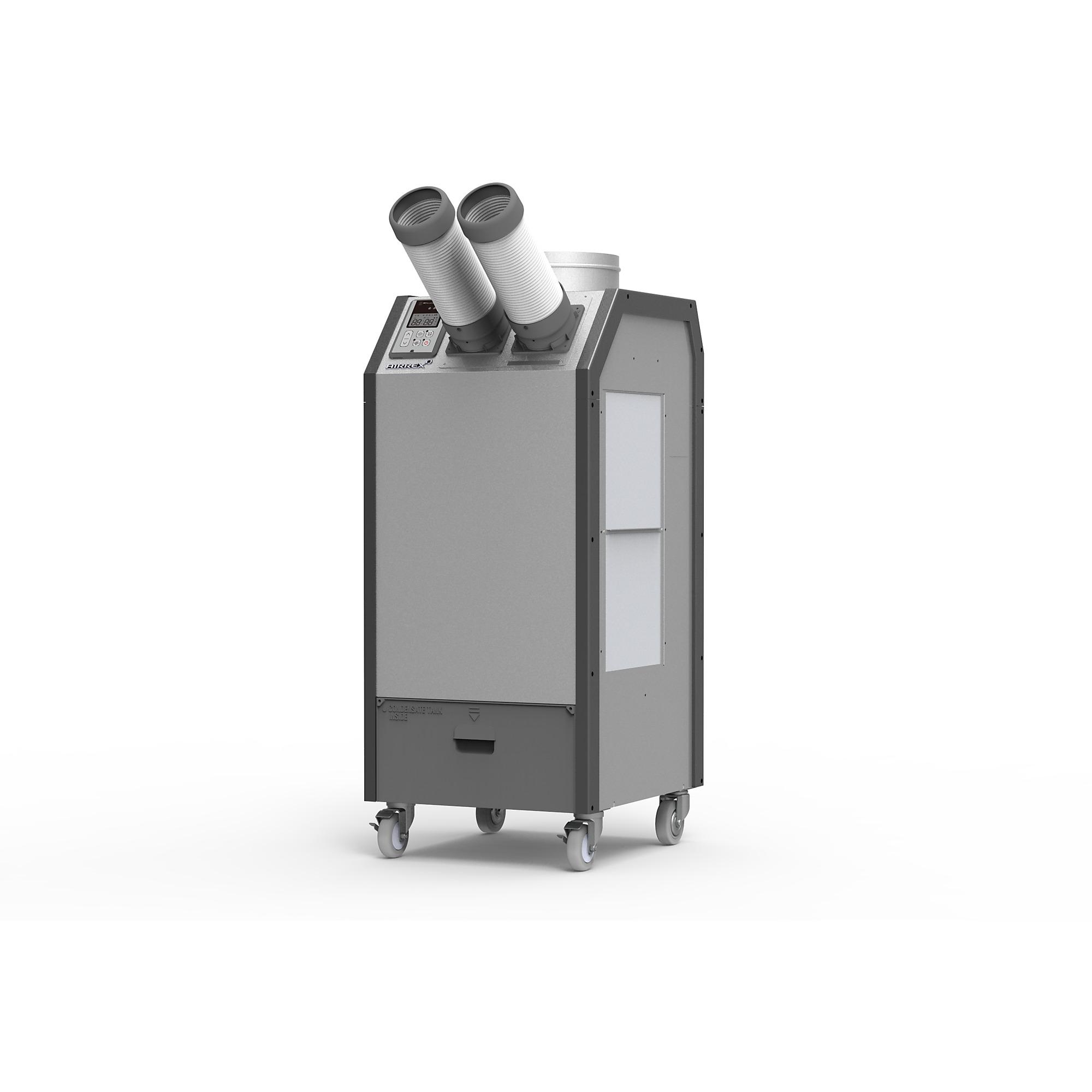
2. Airrex HSC-18R – 1.5-Ton Portable Spot Cooler
For applications requiring additional cooling capacity, the Airrex HSC-18R provides approximately 16,800 BTU/hr of cooling.
This portable spot cooler features adjustable cold-air discharge nozzles that can help direct conditioned air toward selected areas.
Features include:
- Approximately 16,800 BTU/hr cooling capacity
- 1.5-ton product class
- 115V electrical operation
- NEMA 5-20 plug
- R-454B refrigerant
- Washable air filters
- Optional exhaust ducting and condensate pump
The HSC-18R may be appropriate for smaller server rooms or specific hot spots where limited supplemental cooling is required.
An important installation consideration is its electrical connection. The 115V model requires a compatible 20-amp circuit and NEMA 5-20 receptacle rather than a typical 15-amp outlet.
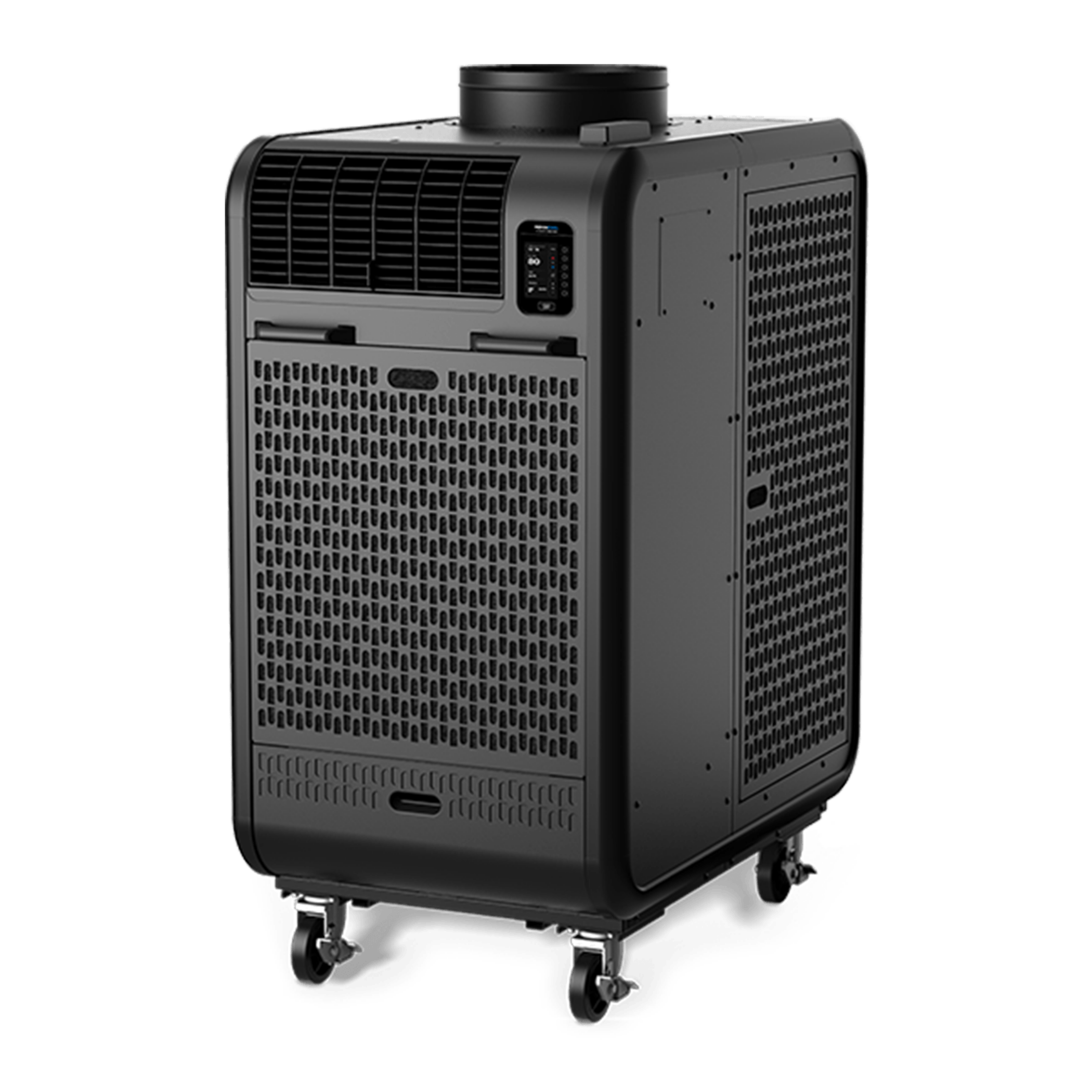
3. Airrex HSC-60R – 5-Ton Industrial Spot Cooler
Larger IT environments may require substantially more cooling capacity than compact spot coolers can provide.
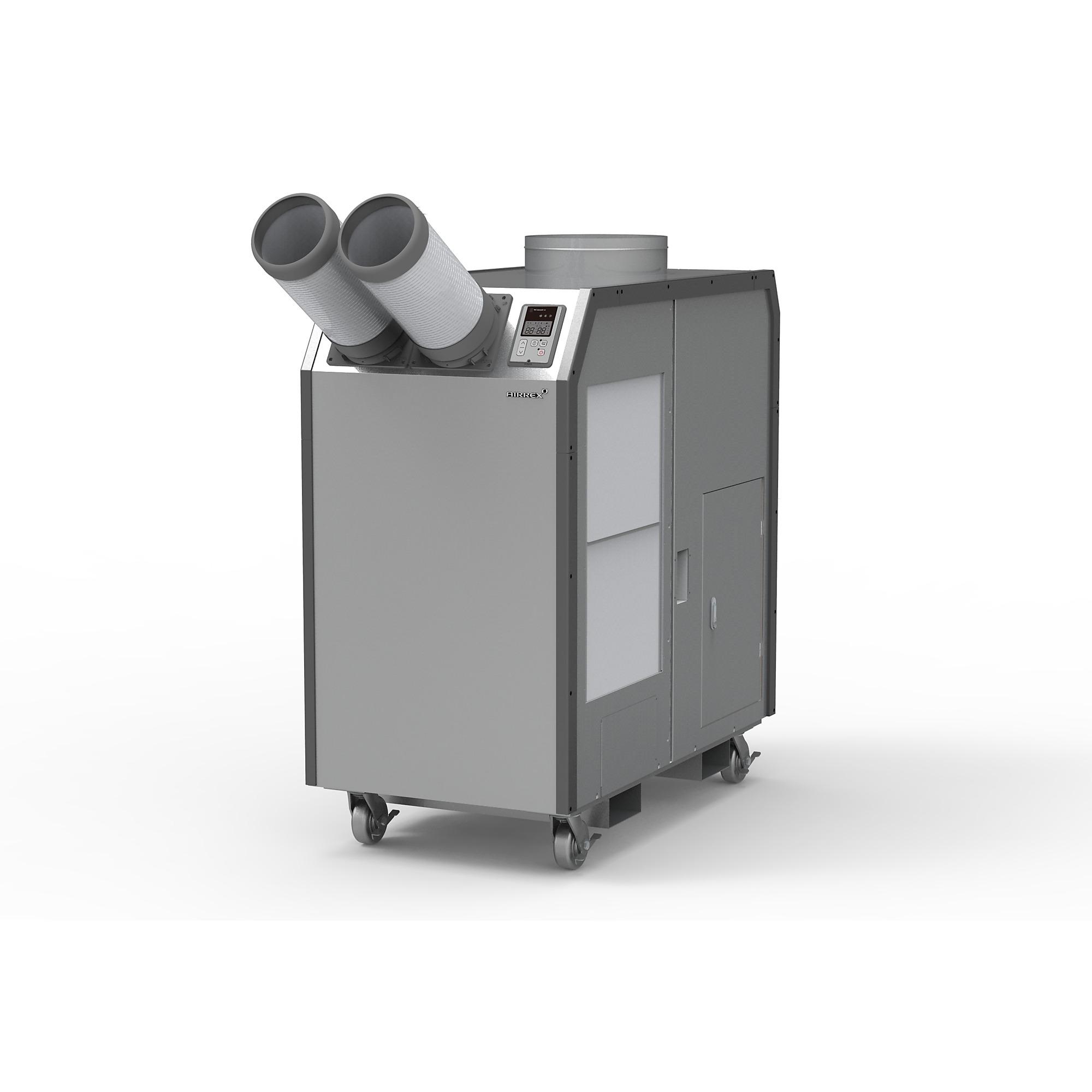
The Airrex HSC-60R is a commercial-grade portable air conditioner offering approximately 60,000 BTU/hr of nominal cooling capacity.
This high-capacity unit is suited for industrial applications and can be evaluated for temporary cooling in larger server rooms, equipment areas, and data-center support spaces.
Key features include:
- Approximately 60,000 BTU/hr cooling capacity
- 5 tons of nominal cooling
- Available in multiple electrical configurations
- R-454B refrigerant
- Industrial portable construction
- Ducting options for air distribution and heat exhaust
The HSC-60R requires appropriate electrical infrastructure and a suitable condenser heat-rejection arrangement.
For facilities with significant IT equipment loads, a 5-ton system can provide considerably more capacity than small portable units while remaining movable.
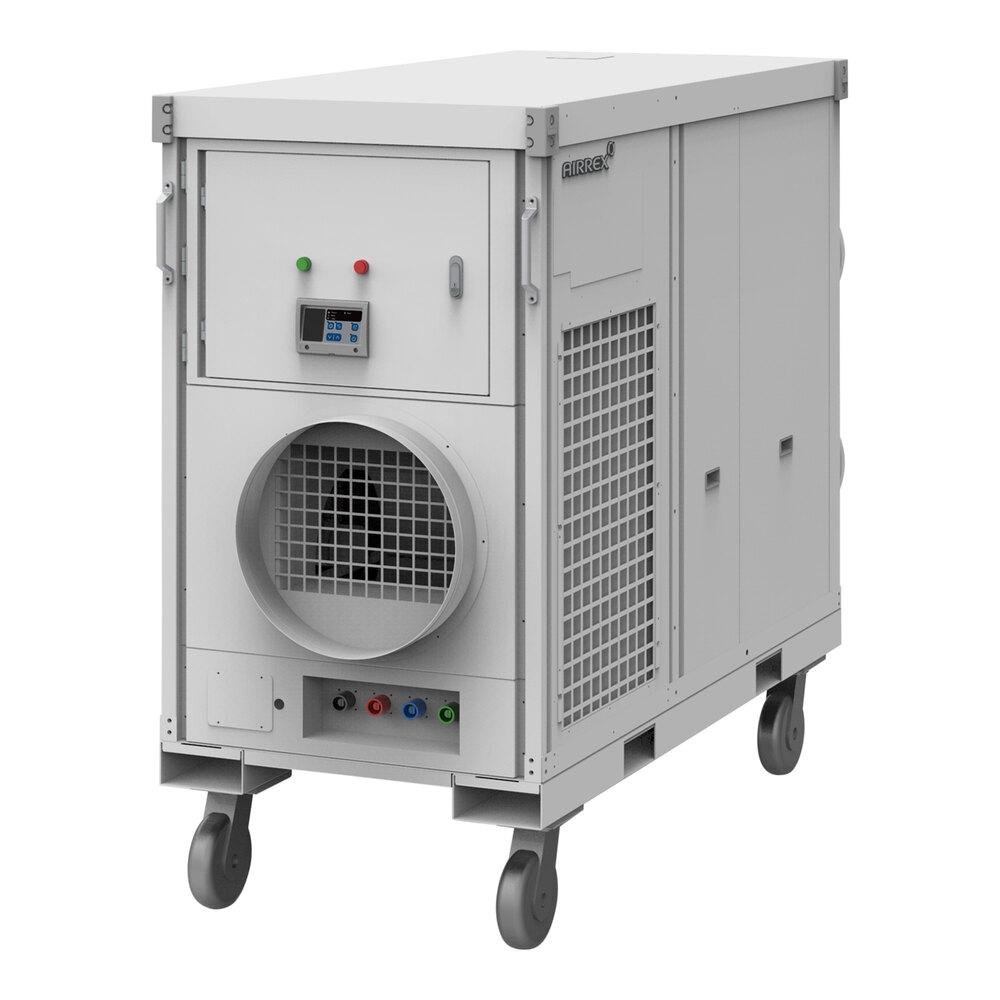
4. Airrex AHSC-140R – 12-Ton Portable Air Conditioner
For high-capacity commercial cooling requirements, the Airrex AHSC-140R offers approximately 145,000 BTU/hr of cooling capacity.
This industrial unit can be considered for larger temporary cooling projects where appropriate power, airflow distribution, and heat-rejection infrastructure are available.
Key features include:
- Approximately 145,000 BTU/hr cooling capacity
- 12-ton nominal cooling class
- 3,530 CFM airflow
- Three-phase electrical configurations
- R-454B refrigerant
- Heavy-duty construction with swivel casters
- Electric heating functionality for applicable commercial uses
The AHSC-140R may be useful for temporary commercial cooling projects, including larger IT support areas and data-center infrastructure work.
Because this equipment requires substantial electrical service and careful installation planning, it is important to confirm the exact model configuration and installation requirements before ordering.
Comparing Portable Air Conditioners for IT Cooling
| Airrex Model | Nominal Cooling Class | Cooling Capacity | Example Application |
|---|---|---|---|
| HSC-12R | 1 ton | 12,000 BTU/hr | Small IT closets or targeted cooling |
| HSC-18R | 1.5 ton | 16,800 BTU/hr | Server rooms and localized hot spots |
| HSC-60R | 5 tons | Approximately 60,000 BTU/hr | Larger equipment rooms and supplemental cooling |
| AHSC-140R | 12 tons | 145,000 BTU/hr | High-capacity temporary commercial cooling |
These examples illustrate the available capacity ranges, not guaranteed suitability for particular room sizes or IT loads.
Actual unit selection should be based on a detailed cooling assessment.
Important Considerations When Installing Portable AC in a Data Center
1. Condenser Heat Exhaust
Portable air conditioners remove heat from the cooled area, but that heat must be rejected somewhere.
For air-cooled portable units, warm condenser exhaust must be directed to an appropriate location outside the conditioned space.
If condenser exhaust is released into the same room being cooled, the overall cooling benefit can be eliminated.
2. Electrical Requirements
Portable air conditioners have different voltage, phase, and circuit requirements.
Smaller units may operate on 115V power, while larger industrial systems require higher-voltage or three-phase connections.
Facilities should verify electrical capacity, receptacle compatibility, circuit protection, and installation requirements before deploying cooling equipment.
3. Condensate Management
Air conditioning equipment can remove moisture from the air during operation.
Depending on the unit and installation, condensate may need to be collected, drained, or pumped to an approved location.
For data centers and IT facilities, condensate lines should be routed carefully to reduce the risk of water exposure near sensitive electrical equipment.
4. Airflow Direction
Cooling capacity alone does not guarantee effective server cooling.
Conditioned air should reach the equipment intake side, while hot exhaust air should be prevented from recirculating into the same intake area.
Careful placement and ducting can make a significant difference in performance.
5. Redundancy and Monitoring
Mission-critical environments should not rely on an unmonitored portable unit as their only cooling safeguard.
Temporary cooling should be incorporated into an appropriate contingency plan that includes temperature monitoring, alarms, equipment redundancy where needed, and escalation procedures.
Portable AC vs. Permanent Data-Center Cooling
Portable air conditioners are useful for emergency response, maintenance periods, temporary installations, and supplemental cooling.
Permanent precision cooling systems, however, are typically designed for the continuous sensible cooling, airflow management, control integration, and redundancy requirements of data centers.
Portable equipment should not automatically be considered a direct replacement for precision cooling infrastructure.
Instead, it can serve as an important temporary solution when properly selected and installed.
Frequently Asked Questions
Can a portable air conditioner cool a server room?
Yes. Portable air conditioners can provide temporary or supplemental cooling for server rooms when their capacity, airflow, exhaust configuration, and electrical requirements are appropriate.
How many tons of AC does a server room need?
Cooling requirements depend primarily on the equipment heat load rather than floor area.
For example, a 20 kW IT load produces approximately 68,240 BTU/hr, equivalent to about 5.7 tons of cooling before accounting for other loads or system performance.
Can portable air conditioners be used during data-center HVAC maintenance?
Yes. Portable cooling equipment is commonly evaluated for planned maintenance, equipment replacement, and emergency cooling situations.
A deployment plan should be established before taking critical cooling systems offline.
Do portable air conditioners require exhaust ducting?
Air-cooled portable AC units generally require an appropriate way to discharge condenser heat away from the conditioned area.
Exact exhaust and installation requirements vary by model.
Are larger industrial portable air conditioners better for data centers?
Not necessarily. Larger units provide greater nominal capacity, but the correct choice depends on the heat load, available electrical service, airflow design, cooling distribution, and heat-rejection options.
Find Portable Data-Center Cooling Equipment at Climate Control Solutions
Whether you’re maintaining a small server room, planning an equipment upgrade, or evaluating temporary cooling for a larger data-center facility, choosing the correct portable air conditioner is essential.
Climate Control Solutions supplies commercial and industrial spot coolers, portable air conditioners, and related accessories from manufacturers including Airrex and Oceanaire.
Our team can help you compare equipment options based on your facility’s cooling requirements and available infrastructure.
Need portable cooling for a data center or server room?
Contact Climate Control Solutions at (800) 633-8711 or browse our portable air conditioners to review available units and request a quote.